



Introduction to Gas Chromatography (GC)
Gas Chromatography (GC) is a modern analytical instrument used to separate, identify, and quantify components in gas mixtures or volatile substances without thermal decomposition.
This method is widely applied in:
- Analytical Chemistry: Determining the composition of organic and inorganic compounds.
- Environment: Analyzing exhaust gases, VOCs, and pollutants.
- Food & Beverage: Testing for solvent residues and flavoring agents.
- Pharmaceuticals: Monitoring volatile impurities.
- Industrial Gases: Determining the composition of gas mixtures and industrial gases.
Operating Principle of GC
GC separates compounds based on differences in their migration speed through the chromatographic column, which depend on:
- Mobile phase (Carrier Gas): Usually helium (He) or nitrogen (N₂), responsible for transporting the sample through the column.
- Stationary phase: A liquid or polymer layer coated onto an inert solid support inside the chromatographic column.
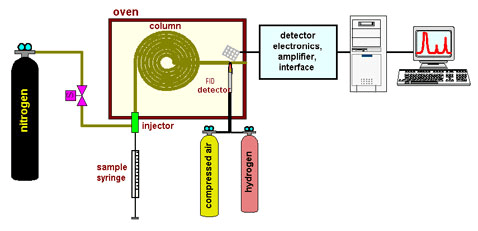
Standard GC System Workflow
| Step | Description | Function |
| 1. Sample Injection | The sample is introduced into the injector at high temperature, where it vaporizes and mixes with the carrier gas. | Converts the sample into a gaseous form. |
| 2. Sample Transport | The carrier gas delivers the mixture into the chromatographic column containing the stationary phase. | Initiates the separation process. |
| 3. Separation | Inside the column, each compound interacts with the stationary phase to different extents: weak interaction → faster movement; strong interaction → slower movement. | Fully separates each compound. |
| 4. Detection | The detector records the retention time and signal intensity of each compound. | Generates chromatographic data. |
| 5. Result Analysis | Retention time is used for identification; peak area/height is used for concentration calculation. | Performs qualitative and quantitative analysis. |
Types of Gases Used in GC
Depending on the detector type, GC systems require different carrier gases, fuel gases, or auxiliary gases.
| Detector | Carrier Gas | Fuel / Auxiliary Gas | Analytical Application |
| FID (Flame Ionization Detector) | He, N₂, H₂ | H₂ (fuel), Air (oxidant) | Flammable organic compounds, VOCs, solvents |
| TCD (Thermal Conductivity Detector) | He, H₂ | None (reference gas only in dual-channel mode) | Inorganic gases (H₂, O₂, N₂, CO₂, CO…), organic compounds, trace gases (ppm–%) in a gas matrix |
| ECD (Electron Capture Detector) | N₂ or Ar + 5% CH₄ (P5 gas) | None | Halogenated compounds, PCBs, organochlorine pesticides |
| FPD (Flame Photometric Detector) | He, N₂ | H₂ (fuel), Air (oxidant) | Sulfur- and phosphorus-containing compounds such as H₂S, COS, organophosphorus compounds |
| NPD (Nitrogen Phosphorus Detector) | He, N₂ | H₂ (fuel), Air (oxidant) | Nitrogen-containing compounds (amines, nitro compounds) and phosphorus-containing compounds (pesticides, organic fertilizers) |
| MS (Mass Spectrometer) | Helium | None | Analysis of most volatile and semi-volatile compounds |
Calibration Gases for GC
In addition to operating gases, GC systems require calibration gases to ensure analytical accuracy.
- Composition: Gas mixtures with known concentrations.
- Purpose:
- Initial calibration during installation or after column replacement.
- Periodic verification to ensure reliable results.
- Supplied only when needed, not for continuous use.
Benefits of Choosing the Right Gas for GC
- Ensures high analytical accuracy.
- Extends the lifespan of the column and detector.
- Optimizes operating costs.
- Enhances separation efficiency and shortens analysis time.
VINA Industrial Gases supplies specialty gases, including pure gases such as Argon, Nitrogen, Helium, and Hydrogen with high purity grades of 99.9992% and 99.9995%. We also provide stable, long-shelf-life calibration gas mixtures with certified accuracy, meeting the strict requirements of gas chromatographs.
Contact VINA Industrial Gases for consultation on specialty gases and gases for gas chromatography systems.